Why Budelli Pink Beach is pink, and why nobody walks on it
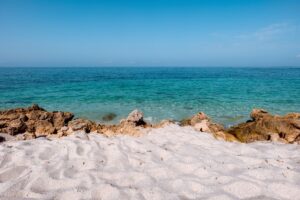
Few beaches all over the worlds are famous both for their colour and for being completely off limits. Budelli Pink Beach is one of them. This small cove on the south-eastern side of Sardinia is known for its faded rose sand, yet visitors have not been allowed to walk on it for almost thirty years.
But what makes Budelli Pink Beach pink? This unique beach owes its colour to a single-celled marine organism, not to coral or to volcanic minerals as is often repeated. Its shell fragments wash ashore, mix with white sand, and tint the whole cove.
The same fragility that produced the colour is what got the beach closed to visitors, after decades in which tourists carried the sand home in bottles.
What gives Budelli Pink Beach its colour
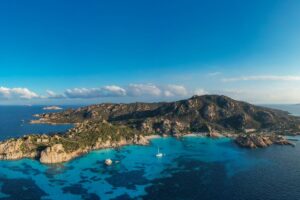
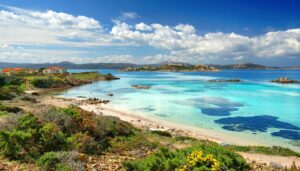
The beach sits in Cala di Roto, on the south-eastern shore of Budelli, an island of roughly 1.6 square kilometres inside the La Maddalena Archipelago National Park.
The colour comes from Miniacina miniacea, a foraminifer: a single-celled organism that builds itself a calcareous shell with a reddish-pink cast. It lives among the rhizomes of Posidonia oceanica, the seagrass that carpets the seabed around the island. When the organism dies, currents carry the empty shells towards the shore, where wave action grinds them into fragments.
Those fragments do not arrive alone. Broken bryozoans, coral debris, shell and granite particles all end up in the same cove, which is shaped in a way that traps sediment rather than flushing it back out.
Three conditions have to hold at once for the effect to appear:
- Healthy seagrass. No Posidonia, no habitat for the organism, no pink fragments. The meadows are the origin of the whole phenomenon.
- The right currents. The fragments are light and travel far. Cala di Roto happens to sit where they accumulate rather than disperse.
- Sheltered geometry. The cove faces away from the dominant weather, so the sediment is not stripped out by winter storms.
Change any one of those and the colour fades. Which is close to what happened.
How the sand was nearly lost
Budelli was barely known until the 1960s. Michelangelo Antonioni filmed part of Il deserto rosso in Cala di Roto in 1964, and the beach began to appear in magazines and travel features.
By the 1990s the island was receiving tens of thousands of visitors a season. Boats anchored directly over the seagrass, tearing up the meadows that produced the fragments in the first place. Visitors filled bottles and bags with the sand and took them home. The two pressures compounded: the source was being damaged at the same time as the product was being removed.
The National Park responded with some of the strictest protection measures in the Mediterranean. Landing was banned, then swimming and snorkelling in the water immediately in front of the cove. Removing sand, pebbles or shells from anywhere in the archipelago became an offence, enforced at the ports.
The island of Budelli itself had a complicated few decades. It passed through private hands, was put up for auction in 2013 and bought by a New Zealand businessman, before the Italian state exercised its right of pre-emption. Budelli returned to the National Park in 2016. For thirty-two years, until 2021, it had a single resident: Mauro Morandi, a former teacher who lived alone on the island as its unofficial caretaker.
The sand has recovered, slowly. It has not returned to what old photographs show.
How to see Budelli Pink Beach today
Manage your expectations before you go, and the visit works. Arrive expecting a shoreline the colour of raspberry, and it will not.
The pink is real but subtle. It reads most clearly in low sunlight, early or late in the day, and it deepens where waves wet the sand. Under midday sun in August, from a boat holding position offshore, it can look closer to pale beige with a rose cast.
The rules are unambiguous:
- No landing. Setting foot on the sand is prohibited, with fines for anyone attempting it. The prohibition is enforced.
- No swimming in front of the cove. The water directly off Cala di Roto is closed to bathing and snorkelling.
- No taking anything away. Sand, pebbles and shells stay where they are, anywhere in the archipelago.
- Boats hold position offshore. Anchoring over seagrass is what caused the damage. Authorised buoys and slow drifting have replaced it.
- Landing restrictions apply elsewhere on Budelli too. Access to Spiaggia del Cavaliere, on the northern side, has been progressively tightened. Check what is permitted in the current season rather than assuming.
Any itinerary that promises a walk on the Pink Beach is either out of date or not telling you the truth. The realistic version is a viewing stop from the water, usually combined with the Natural Pools, the shallow channel between Budelli, Razzoli and Santa Maria, where swimming is permitted and the water sits waist-deep over pale sand.
Seeing Budelli and the Pink Beach with Gite in Barca
We have been working these waters for over thirty years and leave daily from both Palau and La Maddalena, May to October.
Our full-day excursions include a viewing stop at Cala di Roto and a swim stop at the Natural Pools, alongside Spargi, Santa Maria and La Maddalena. Itineraries follow National Park rules, which is why the crew will not take you closer to the sand than the regulations allow, and why we say so before you book a La Maddalena boat tour, rather than after.
Adult, child and infant prices are listed in full on the site. For anything else, get in touch.
Glossary
- Miniacina miniacea. A foraminifer, meaning a single-celled organism that secretes a chambered calcareous shell. Its pink shell fragments are the origin of the beach’s colour.
- Posidonia oceanica. The seagrass that forms underwater meadows across the archipelago. It is the habitat of the organism, and the reason anchoring is restricted.
- Cala di Roto. The cove on Budelli’s south-eastern shore that holds the Pink Beach.
- Bryozoan. A colonial marine invertebrate. Its broken skeletal fragments contribute to the sand alongside the foraminifer.
- Natural Pools. The shallow channel between Budelli, Razzoli and Santa Maria, also known as Porto della Madonna.
- Mooring buoy. A fixed anchoring point used inside protected waters, in place of dropping anchor onto the seagrass meadows below.