What makes Spargi island, Sardinia’s emptiest, worth the stop
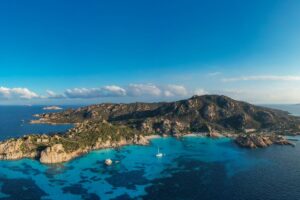
Four square kilometres of pink granite, no houses, no roads, no jetty for the public. From the water it looks like a place that was passed over. It was not: it was used for six thousand years and never settled.
Spargi island, in Sardinia, is the third largest in the Maddalena Archipelago National Park and the largest one nobody has ever lived on. Its interior is nearly impassable scrub, its coastline runs about eleven kilometres, and almost every day boat in the archipelago stops on its southern side.
Below, five things about the island that the standard itinerary description leaves out.
What to know about Spargi Island in Sardinia
Most day boats stop at Spargi for an hour and describe it in one line: uninhabited, granite, good swimming. All true, and none of it explains why an island nobody could live on has been in constant use for six thousand years.
Here’s five things worth knowing before the boat drops anchor.
1. Nobody has ever lived on Spargi island in Sardinia
Of the larger islands in the archipelago, only La Maddalena is permanently inhabited and Caprera has had residents. Spargi has had neither, and the reason is geological rather than legal.
The island is granite almost the whole way through, with thin soil and no reliable fresh water. Its interior rises into scrub-covered rock that is difficult to cross on foot even now. Shepherds and fishermen used the coast; nobody built a village inland because there was nothing to farm and nothing to drink.
What survives from that non-settlement is a coastline that looks much as it did two centuries ago.
2. A Roman cargo ship lies off Cala Corsara
In the shallows off the island’s most famous beach sits the Spargi wreck: a Roman merchant vessel roughly 35 metres long, dated to the second century BC, lying at around eighteen metres.
It was located in the 1930s and excavated in the decades that followed. Its cargo of amphorae is held in the naval archaeological museum on La Maddalena, which means you can see the ship’s contents on land and the site itself only on an authorised dive.
The wreck is a reminder of what these waters were before tourism: a working route through the Strait of Bonifacio.
3. The rocks at Cala Corsara have faces
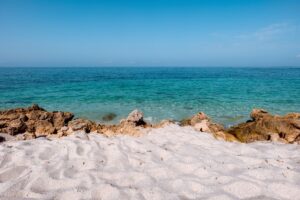
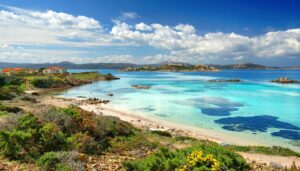
Cala Corsara is not one beach but four small stretches of pale sand, separated by granite outcrops that wind and salt have worked into recognisable shapes.
The best known sits on the western side of the cove and is called the Witch’s Rock, for a profile that reads unmistakably as a hooked nose and chin. Another formation nearby is known locally as the bulldog. The process behind them is called tafone weathering: salt crystallising inside the rock hollows it out from within, leaving cavities and ridges.
None of it is carved. It is what granite does when left alone for long enough on a windward coast.
4. Spargi island was a military position
From the late nineteenth century through the Second World War, the archipelago’s position between Sardinia and Corsica made it strategically valuable, and Spargi was fortified accordingly.
Gun batteries and observation posts were built directly into the granite on the northern and western sides, camouflaged well enough that they are easy to miss from a passing boat. Behind the emplacements stood magazines, barracks, cisterns and ovens; a narrow rail line once moved shells to the guns.
Most of it is abandoned now and slowly returning to scrub, visible from the water as straight lines where the rock should be irregular.
5. Obsidian traders stopped here in the Neolithic
Archaeological material recovered from a tafone on the shore at Cala Corsara includes obsidian, the volcanic glass traded across the western Mediterranean from Sardinian sources long before the Romans.
The finds suggest the island served as a waypoint on the crossing between Sardinia and Corsica rather than a destination. Boats stopped, sheltered, and moved on. Six thousand years later the pattern has not changed much: Spargi is still somewhere people stop rather than stay.
Today the shelter is legal as well as physical. The whole island sits inside the La Maddalena Archipelago National Park, which is why anchoring is restricted to authorised moorings and nothing may be taken off the beaches.
Visiting Spargi island with Gite in Barca
With over thirty years of experience navigating these waters, we welcome you aboard our Lady Luna 3, from May through October, with convenient departures from both Palau and La Maddalena.
Our full-day excursions include a swim stop at Spargi Island alongside Budelli, Santa Maria and La Maddalena in a single day, with a sun deck, indoor seating, a bar and a crew that speaks five languages. Itineraries follow National Park rules.
Adult, child and infant prices are listed in full on the site. For help choosing a departure port, get in touch.
Glossary
- Cala Corsara. The cove of four small beaches on Spargi’s southern side, and the stop most day boats make.
- Tafone. A cavity hollowed out of granite by salt crystallising inside the rock. The process behind the island’s shaped boulders.
- Spargi wreck. A Roman merchant ship of the second century BC, lying off Cala Corsara; its cargo is held on La Maddalena.
- Obsidian. Volcanic glass used for tools and traded across the Mediterranean in the Neolithic, with Sardinia among its sources.
- Mooring buoy. A fixed anchoring point used inside protected waters, in place of dropping anchor onto the seagrass meadows below.