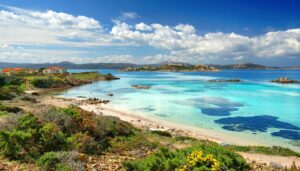
The best beaches in north Sardinia, and how you actually reach them
Two beaches, twenty minutes apart on the map. One has a car park, a kiosk and a hundred umbrellas by ten in the morning. The other has no road to it at all, and on most days holds fewer than a dozen people.
The best beaches in north Sardinia divide neatly by access rather than by scenery, and that is the useful way to plan them. Some you walk to from a car park. Some need a dirt track and shoes you do not mind ruining. Some sit on uninhabited islands inside a National Park and can only be reached by boat.
Below, the north coast sorted that way: what you can drive to, what takes some effort, and what needs a hull under you.
North Sardinia beaches you can drive to
The Gallura coast, from Santa Teresa down to Olbia, has the highest concentration of road-accessible beaches on the island. Granite headlands, short sandy bays, and car parks that fill by mid-morning in August.
- La Pelosa, Stintino. Shallow turquoise water and a Spanish watchtower offshore. Visitor numbers are capped in summer and entry must be booked in advance, with a fee. Arrive without a booking and you will not get on the sand.
- Rena Bianca, Santa Teresa Gallura. Walking distance from the town centre, which makes it the easiest option on the whole north coast if you are without a car.
- Capo Testa. Not one beach but a granite peninsula with coves on both sides, wind-carved into shapes that draw photographers year-round. Rena di Ponente and Rena di Levante sit either side of the isthmus.
- Porto Istana, near Olbia. Sheltered, shallow, and facing Tavolara across the water. The most family-friendly stretch near the airport.
- Cala Brandinchi, San Teodoro. Sometimes called Little Tahiti. Access is capped and paid in high season here too.
Two things to know before setting out. Parking near the most popular beaches is paid from June to September and fills early. And several of the best-known bays now operate booking systems introduced to control visitor numbers, which change season by season and are worth checking a few days ahead rather than on the morning.
Best beaches in north Sardinia worth the walk
A short walk filters out most of the crowd. These are reachable without a boat, but not without effort.
- Cala Coticcio, Caprera. Often called Sardinian Tahiti. Access is by guided visit only, with numbers capped and booking required; the walk in crosses rough granite and takes roughly forty minutes each way.
- Cala Corsara approach paths, Spargi. Reachable on foot only once you have landed by boat, but the short walk between the coves is what makes the stop worth extending.
- Spiaggia del Principe, Costa Smeralda. A path down from the road, no facilities at the bottom, and a bay that stays quieter than its famous neighbours as a result.
- Cala Sabina, Golfo Aranci. Reachable by a coastal path from the town, or by a train that stops nearby in summer.
Bring water. None of these have a bar at the bottom, and the walk back up in August afternoon heat is the part people underestimate.
The best beaches you can only reach by boat
The La Maddalena Archipelago sits a few miles off the Gallura coast: 62 islands and islets, protected as a National Park since 1994. Only two of them, La Maddalena and Caprera, have roads. Everything else is reached by sea or not at all.
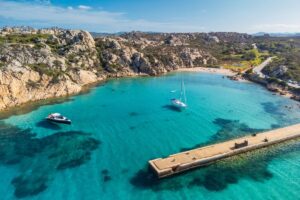
- Cala Corsara, Spargi. Pale sand, granite boulders shaped by wind into recognisable forms, and a seabed shallow enough to snorkel straight off the boat.
- The Natural Pools, between Budelli, Razzoli and Santa Maria. A basin of waist-deep water enclosed by three islands, sheltered from the currents of the Strait of Bonifacio. Swimming is permitted, and most day boats stop here longest.
- Cala Santa Maria, Santa Maria. Long, shallow and sandy. The gentlest water in the archipelago for children.
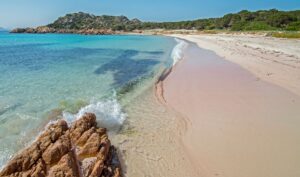
- The Pink Beach, Budelli. Viewed from the water only. Landing has been prohibited for close to thirty years, and the ban is enforced.
Protection is the reason these beaches still look the way they do. Anchoring is permitted only on authorised buoys, because dropping anchor onto the seagrass meadows below destroys a plant that takes decades to regrow. Removing sand, pebbles or shells is an offence anywhere in the archipelago, checked at the ports.
It also means that any operator promising a walk on the Pink Beach is either working from old information or not being straight with you.
Reaching the best island beaches with Gite in Barca
We have been working these waters for over thirty years and leave daily from both Palau and La Maddalena, May to October.
Our full-day excursions cover Spargi, Budelli, Santa Maria and La Maddalena in a single day aboard Lady Luna 3, with swim stops at anchor, a sun deck, indoor seating, a bar and a crew that speaks five languages. Itineraries follow National Park rules.
Adult, child and infant prices are listed in full on the site. For help planning around your base on the coast, get in touch.
Glossary
- Gallura. The north-eastern region of Sardinia, running from Santa Teresa down to Olbia, characterised by granite landscapes and a heavily indented coastline.
- Natural Pools. The shallow basin between Budelli, Razzoli and Santa Maria, also known as Porto della Madonna.
- Posidonia oceanica. The seagrass forming underwater meadows across the archipelago. It is why anchoring is restricted to fixed buoys.
- Mistral. The north-westerly wind of the western Mediterranean, which determines which side of the islands is sheltered on any given day.
- Access cap. A limit on daily visitor numbers, applied at several Sardinian beaches to control erosion and crowding. Usually requires booking and a fee.